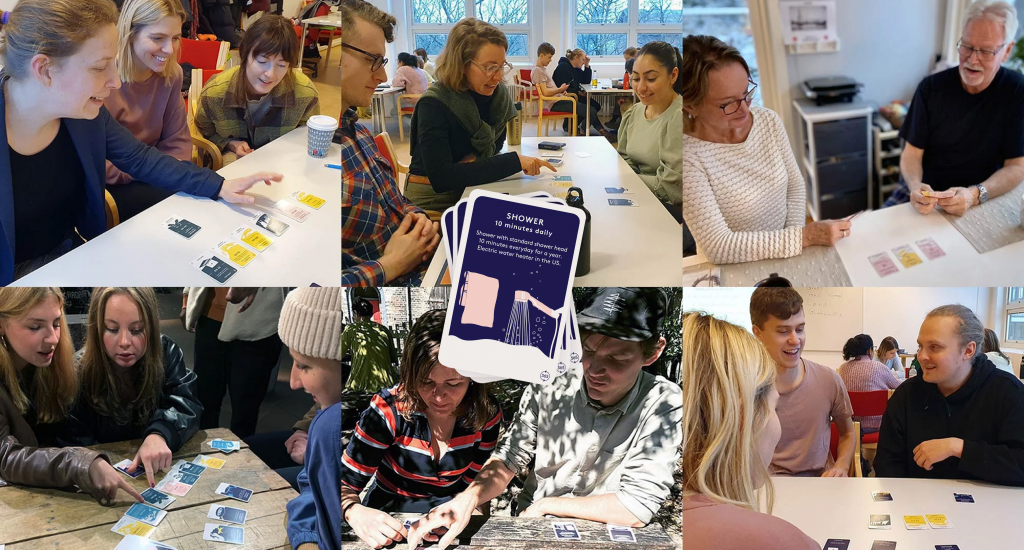
Can a card game change how teachers approach climate and sustainability education in schools? Yes, actually! A new scientific study from the University of Gothenburg shows that games like Climate Call can serve as important tools in both climate education and broader environmental and sustainability education (ESE). By combining facts, discussion and reflection, the game helps teachers spark engagement and strengthen both knowledge and critical thinking in their students.
How the research was conducted
The study, titled “Using games in environmental and sustainability education: identifying teaching traditions in a game about carbon dioxide emissions”, was published on 25 August 2025 in the international journal Environmental Education Research. It is based on a systematic analysis of Climate Call (Klimatkoll in Swedish) and its accompanying teaching materials in Swedish, and also provides an overview of environmental and sustainability education (ESE) in Sweden and different selective teaching traditions. The article additionally draws on previous research into how climate change and carbon dioxide emissions have been addressed in schools, and discusses games as educational artefacts for learning.
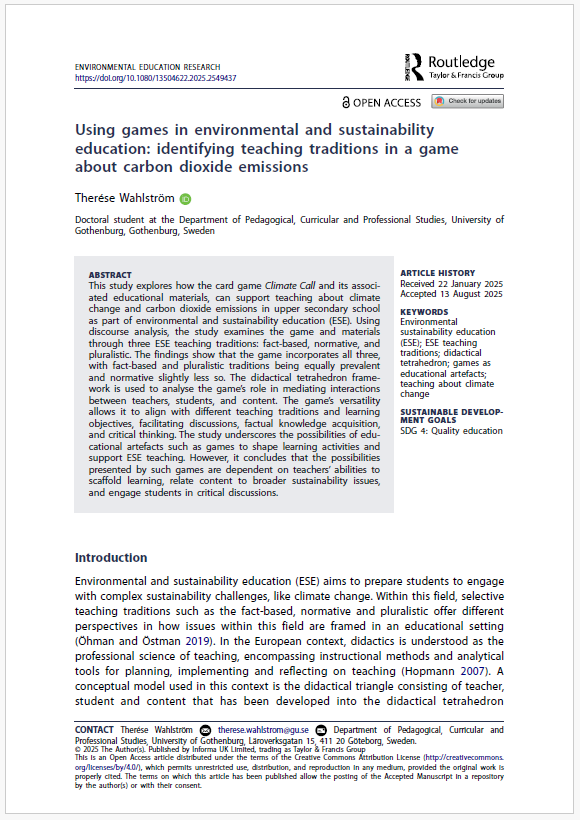
Therése Wahlström, a doctoral student at the Department of Pedagogical, Curricular and Professional Studies at the University of Gothenburg, reviewed all material available to teachers in Swedish: ten exercises, a teacher’s guide, presentation materials and game rules. The analysis was conducted as a discourse analysis, in which the content was categorised according to three selective teaching traditions – fact-based, normative and pluralistic.
The study was conducted as part of Therése Wahlström’s doctoral research.
Three ways to teach – and the game's role in each
In the study, Climate Call was analysed through three selective teaching traditions within environmental and sustainability education (ESE) – fact-based, normative and pluralistic – using a framework developed by Öhman & Östman (2019).
- THE FACT-BASED TRADITION – here, facts take centre stage. Students learn about scientific relationships, such as the climate impact of different greenhouse gases and how to calculate the total carbon emissions from various products or activities. This type of teaching aims to give students a solid factual foundation and a scientific understanding of climate issues.
- THE NORMATIVE TRADITION – here, the focus is on values and attitudes. The goal is for students to develop more sustainable behaviours and outlooks. This aligns closely with the school’s mission to promote sustainable habits and behaviours, and to shape students into active citizens with respect for democratic values and sustainable development. The Swedish national curricula for compulsory school (Lgr22) and upper secondary school (Gy11) state clearly that: “teaching should illustrate how the functions of society and our ways of living and working can be adapted to create sustainable development.”
- THE PLURALISTIC TRADITION – here, dialogue and critical thinking are emphasised. Students encounter different perspectives, reflect, argue and form their own views on complex issues. By comparing their own reasoning with that of others, they develop both democratic competence and the ability to reason about sustainability issues that have no simple answers.
The study shows that Climate Call and its accompanying teaching materials encompass all three selective teaching traditions, but that the fact-based and pluralistic elements are particularly strong. This means that teachers can primarily use the game to convey concrete knowledge about emissions and climate impact, and to create meaningful discussions in which students question, reflect and debate. To a lesser extent, the game can also be used to influence students’ attitudes and values in a sustainable direction.
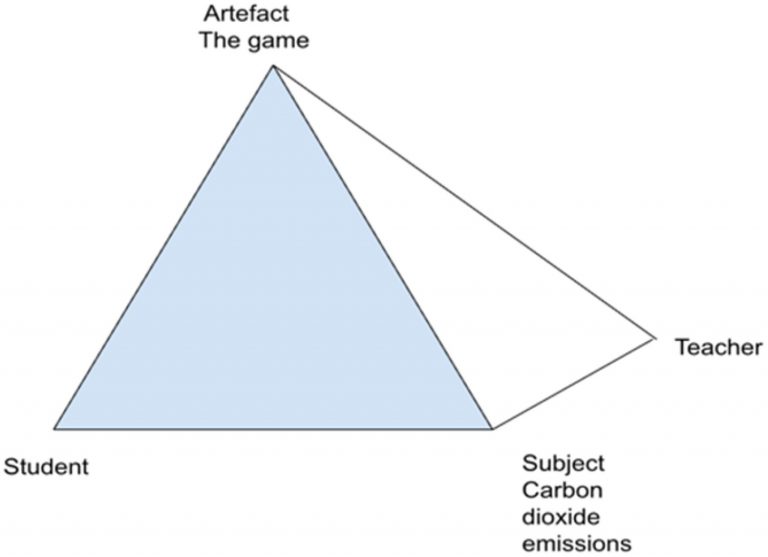
The image below is taken from the article and shows the so-called didactical tetrahedron (after Rezat and Sträßer, 2012). The model illustrates the interplay between four central components of the teaching situation: teacher, student, content and artefact (e.g. Climate Call).
Collaborative learning through social interaction
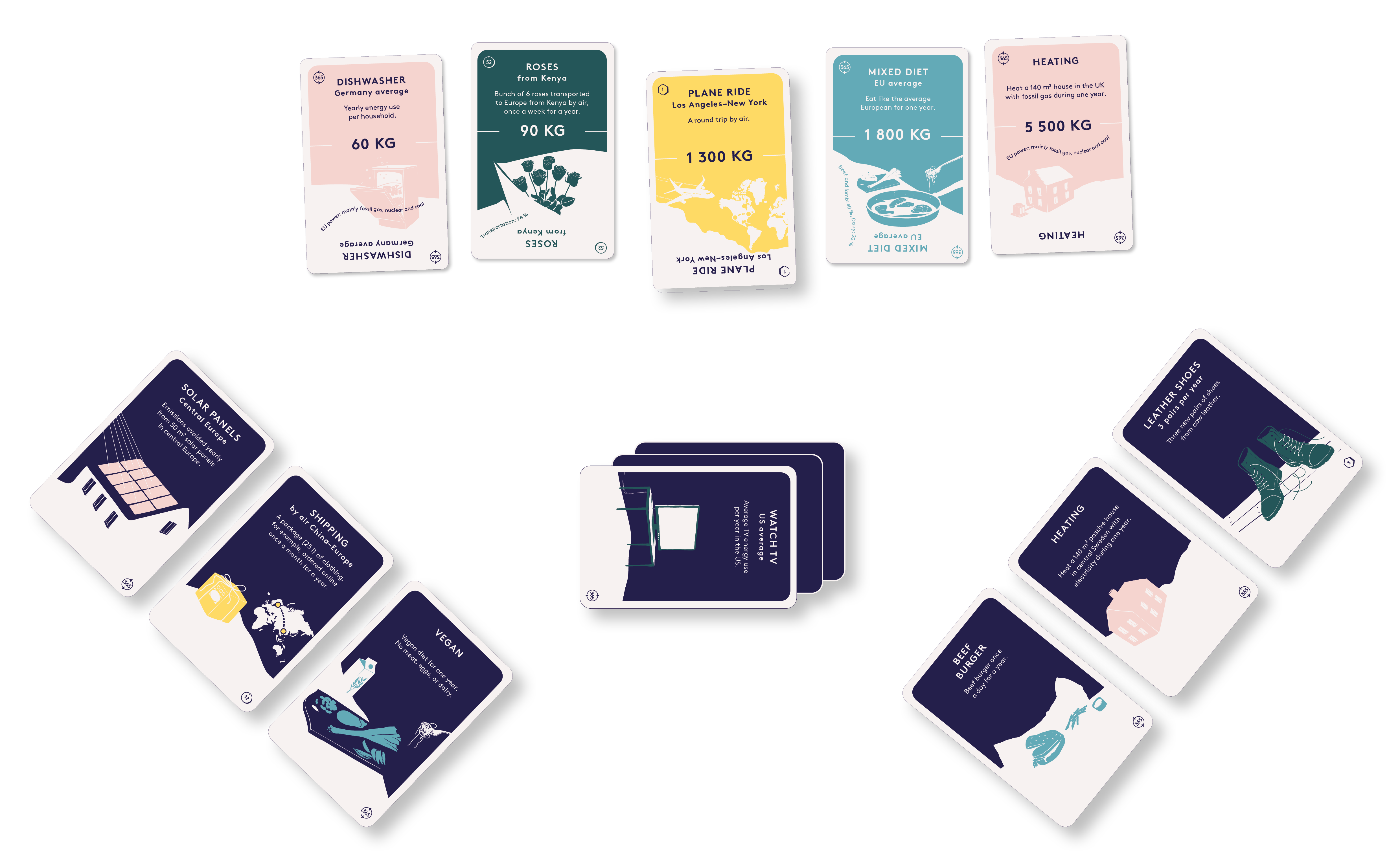
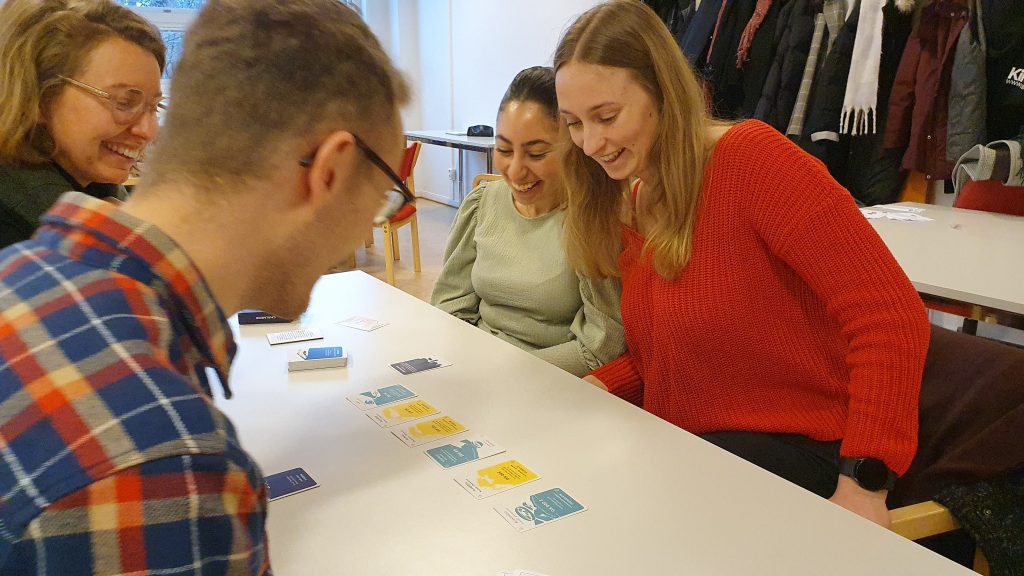
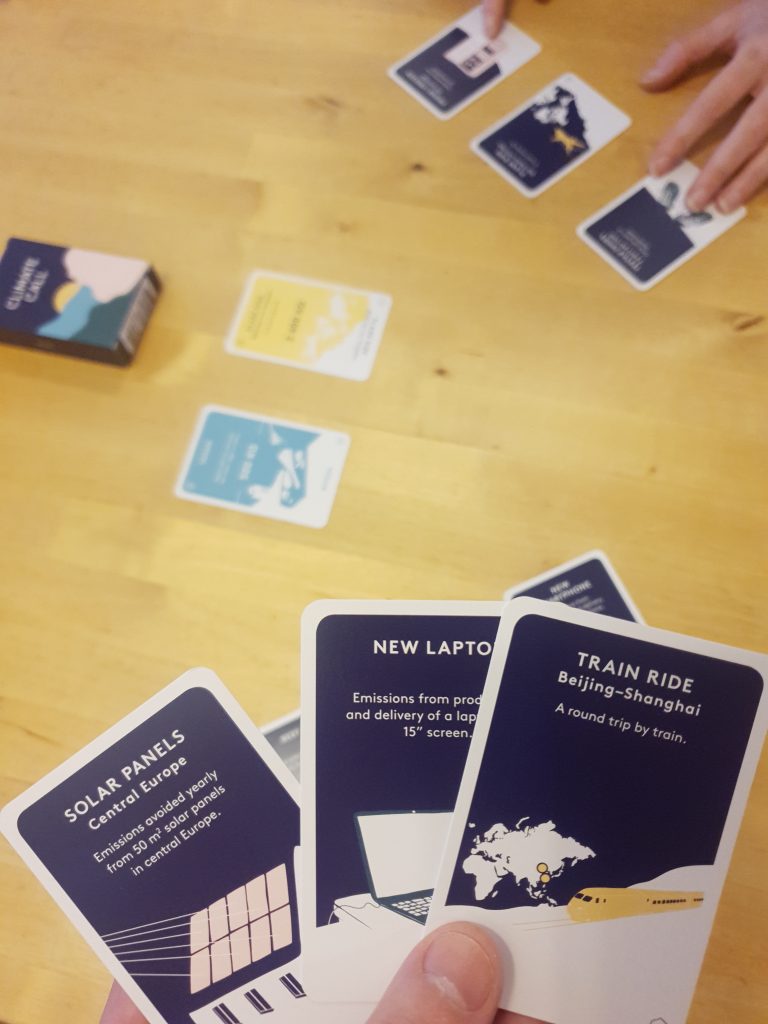
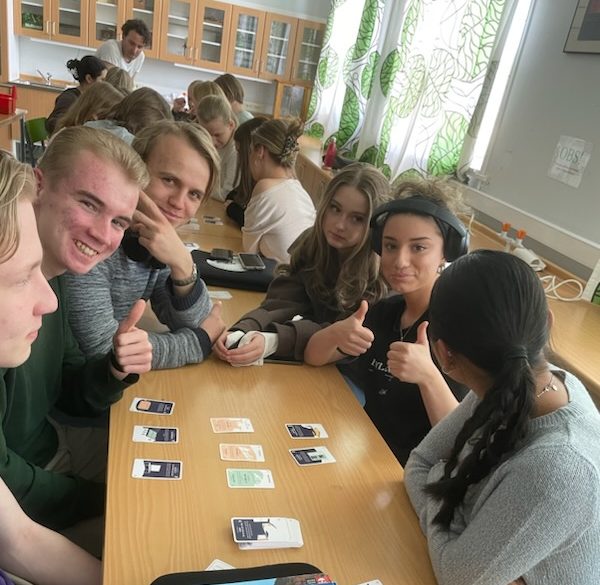
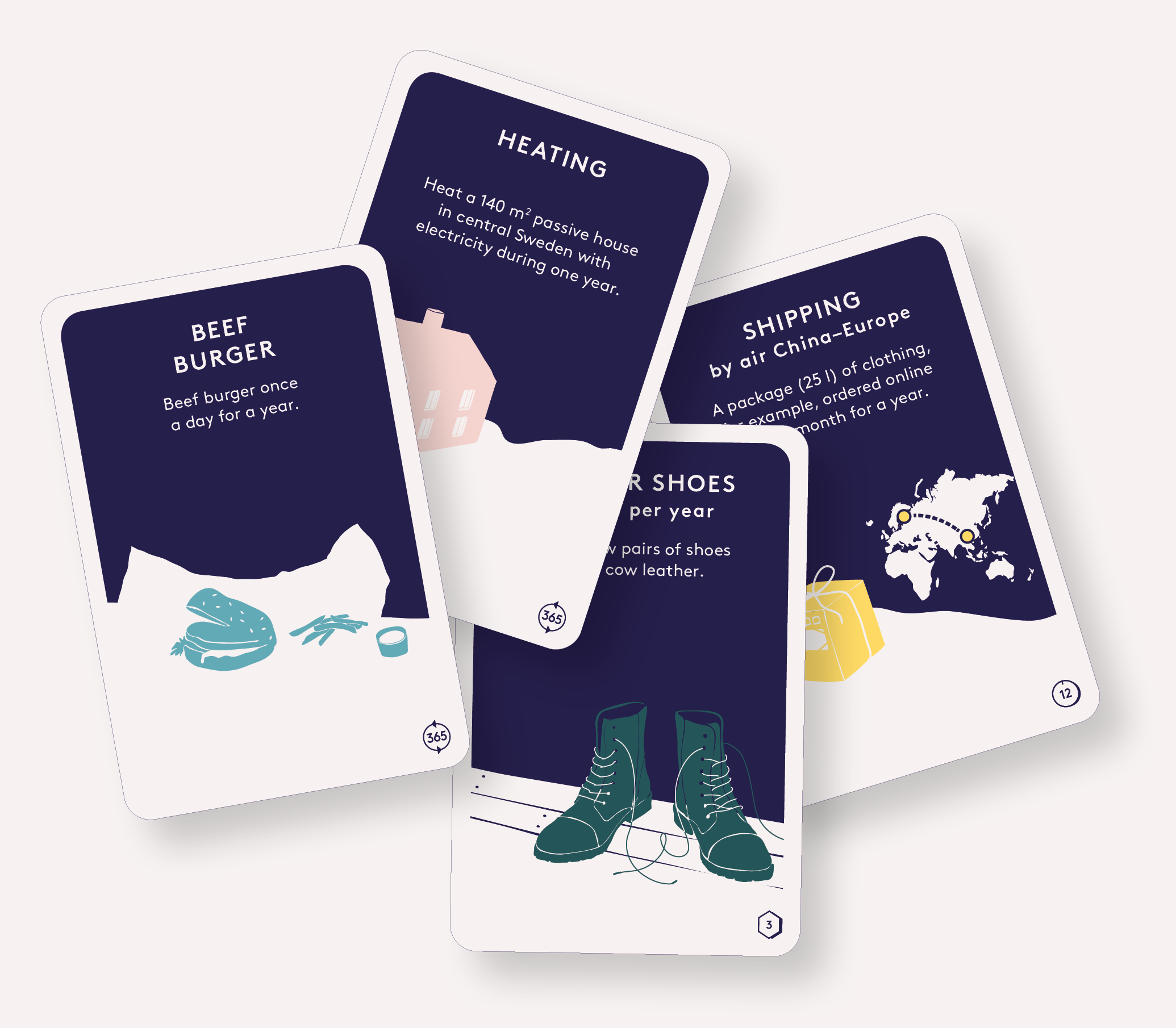
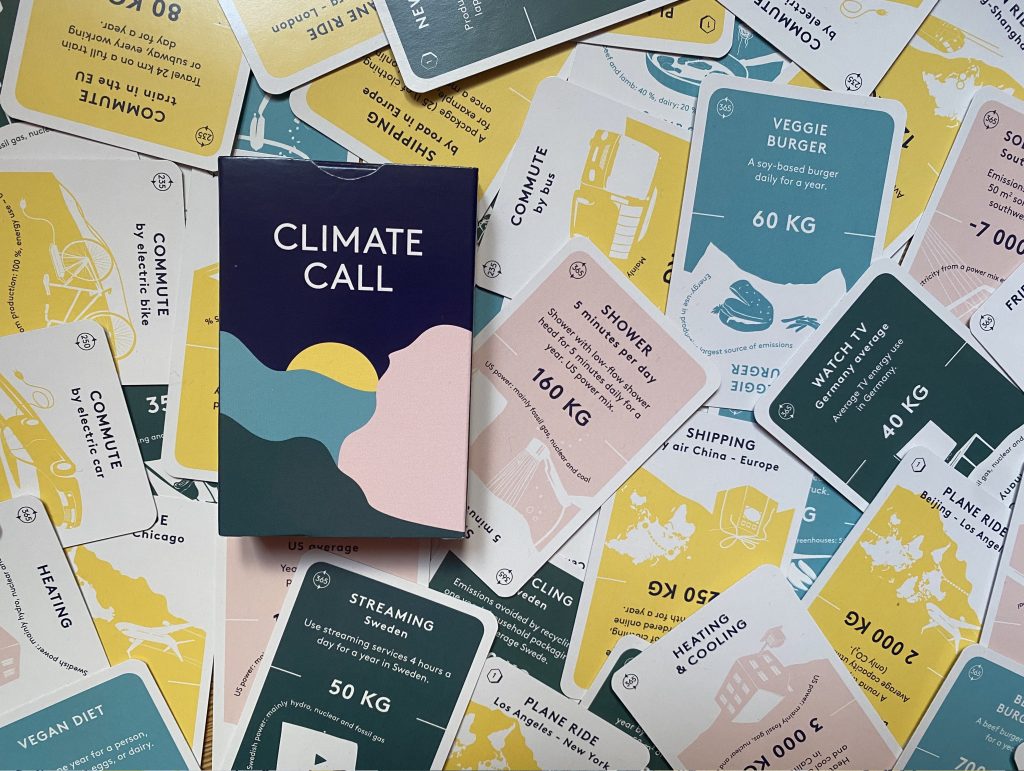
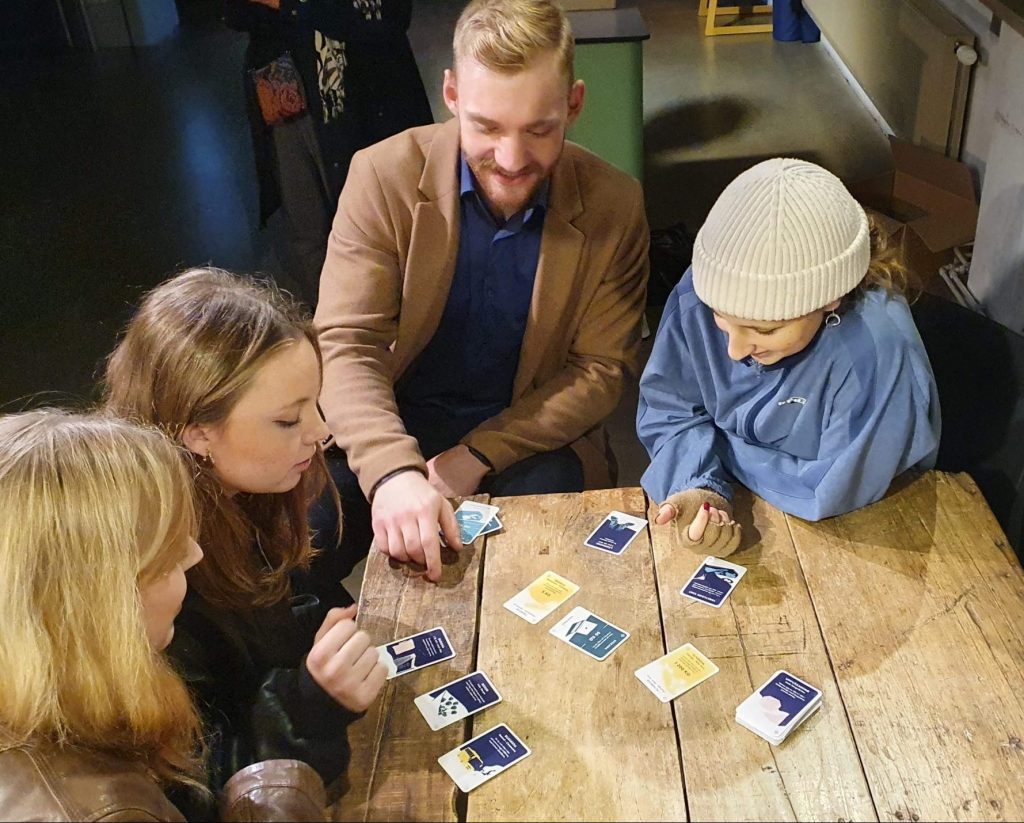
Climate Call is straightforward: each card shows an everyday activity or product, and students’ task is to guess whether its carbon emissions are higher or lower than those of other activities. As more cards are laid on the table, a clear picture emerges of how our everyday choices affect the climate. That factual knowledge is important – but the research study shows that it is the conversations around the game that make the greatest difference. When students discuss, compare their assumptions and are sometimes surprised by the results, collaborative learning takes place. It is this social interaction that makes Climate Call more than a game – it becomes a tool for understanding, reflecting and exploring the world together.
Accompanying teaching materials – a complete toolkit for teachers
Wahlström did not only examine the game itself, but also analysed the ten classroom exercises that accompany Climate Call. These range from fact-based tasks in which students practise calculating emissions, to open-ended exercises where they can envision the future or take the game home to their families. Some examples:
- “CALCULATE YOUR OWN CARDS” – students design their own game cards using emissions data. Facts, emissions calculations and mathematical skills take centre stage.
- “CLIMATE VISIONARIES” – an exercise in which students imagine what the world might look like after a successful climate transition. Creativity, reflection and pluralistic discussions are emphasised.
- “PLAY AT HOME” – students take the game home and return to the classroom with new insights from conversations with family and friends.
Take a look at all our classroom exercises in English here!
All exercises were reviewed and categorised according to the three selective teaching traditions. The image below is taken from the article and shows the distribution of teaching traditions across the ten teaching materials associated with Climate Call. The bar chart shows how often the three traditions – fact-based (blue), normative (orange) and pluralistic (grey) – appear in each material.
The results show that the materials cover the full spectrum: from fact-based knowledge transfer, through value-based exercises aimed at influencing attitudes, to pluralistic elements that encourage critical discussions.
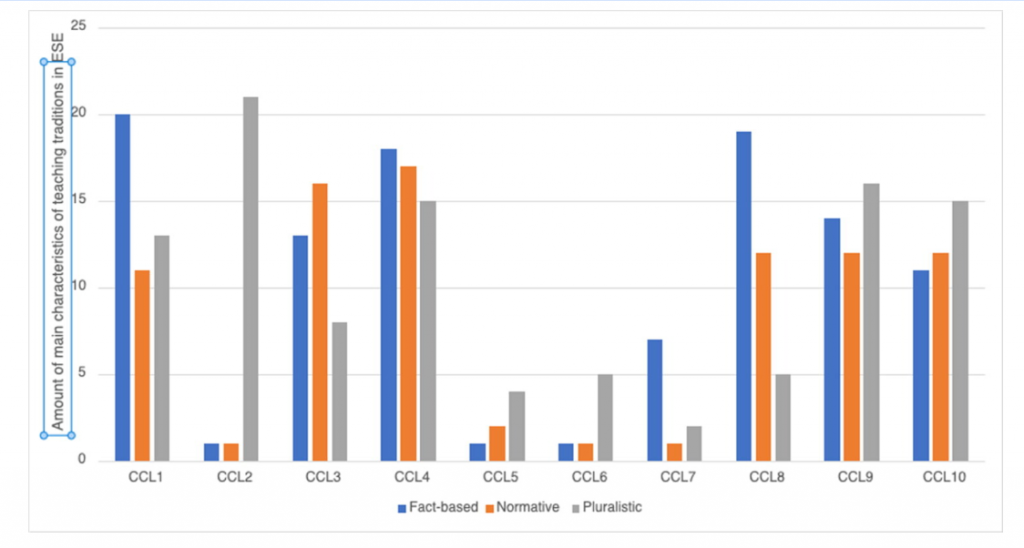
Overall, the study found that the fact-based and pluralistic elements are equally prevalent, while the normative elements are somewhat less so. This is very much in line with the idea, or principle, that has guided our work from the very beginning: not to lecture people or tell them what to think and do, but instead to offer a tool that sparks curiosity and gives people the space to discover, reflect and draw their own conclusions.
In other words: Climate Call, together with its accompanying teaching materials, constitutes a versatile and flexible resource bank that teachers can use to build lessons in a variety of ways, depending on the purpose of their teaching.
The research conclusions – what do they mean for teachers?
The findings of the research study are clear: games – with Climate Call as an example – function as flexible learning resources that can be adapted to different selective teaching traditions, from fact-based knowledge transfer to values-based exercises and open, democratic discussions. The study also points to several important takeaways for teachers:
- FLEXIBILITY IS KEY. The same game can be used in different ways depending on the teacher’s goals. Want to focus on facts? Or develop students’ critical thinking? Climate Call works for both.
- THE TEACHER MAKES THE DIFFERENCE. The conclusion is clear: the game’s potential depends on how the teacher uses it. Games and exercises need to be placed in a broader context, linked to specific learning objectives and complemented with reflection – a process the research refers to as scaffolding.
- DISCUSSIONS CREATE DEPTH. Facts alone do not change behaviours. But when students get to discuss, question and relate content to their own experiences, understanding grows – and so does the motivation to act.
Therése Wahlström summarises her study as follows:
“My research shows that games, such as Climate Call, can function as flexible teaching tools. They can be used to practise factual knowledge, create democratic discussions in the classroom and inspire students to develop their own values. But the full potential of games depends on the teacher’s ability to place them in the right context and to stimulate reflection.”
For us at Climate Call, this research study confirms something we have long observed in our interactions with teachers and students: the game engages, sparks conversation, helps build knowledge, and brings climate issues to life.
Games as educational tools
The study places Climate Call in a broader context: games as educational tools within environmental and sustainability education (ESE). Research shows that games can make complex issues more accessible, create engagement and reduce feelings of climate anxiety.
This is not the first time Climate Call has received recognition for its educational potential. In 2023, the Estonian version of the game was named “Best Environmental Education Tool” by Estonia’s Ministry of Climate.
Read more about the award from Estonia’s Ministry of Climate here
Now the game has also gained scientific backing: Climate Call proves to be not only an engaging addition to teaching, but also an educational artefact that can deepen learning, strengthen students’ critical thinking and inspire sustainable attitudes and values.
Why this matters right now
Climate change is one of the greatest challenges of our time. For students to be able to understand, navigate and influence the future, we need teaching methods that both inform, engage and strengthen belief in the future.
This is where research shows that games can be a way forward. Climate Call becomes more than just a game – it is a bridge between facts and emotions, between science and everyday life, between the classroom and society.
What happens next?
The study is based on a theoretical analysis of the game and its materials. Wahlström now plans to move forward with empirical studies in classroom settings, to investigate how Climate Call is actually used by teachers and students – and how the interplay between the game, the teaching situation and the student perspective influences learning. These are findings we very much look forward to, as they will deepen our understanding of the game’s educational possibilities.
Summary – three insights for teaching
Based on the research, we can highlight three key insights for teachers who want to use Climate Call in their teaching:
- KNOWLEDGE TAKES ROOT THROUGH CONVERSATION. Students remember and reflect more when they get to discuss facts than when they simply receive them.
- THE GAME IS A FLEXIBLE RESOURCE. It can be used in many different ways, from practising mathematical calculations to envisioning the future and discussing current sustainability issues.
- THE TEACHER’S ROLE IS CRUCIAL. Climate Call is a tool – but it is the teacher who makes it a meaningful part of the learning experience.
Would you like tips and advice on how to teach about climate and sustainability? Don’t hesitate to get in touch at hello@climatecallgame.com! We are happy to share experiences, exercises and materials that can inspire your teaching – and we are always keen to hear about the challenges you face in the classroom.
Would you prefer to book us for an inspiring lecture or interactive workshop? Click the link below!
Want to try Climate Call in your teaching?
Are you a teacher in lower or upper secondary school? Looking for new, tried-and-tested and engaging ways to teach? Try our educational and informative card games, suitable for a wide range of subjects! A teacher kit consists of five games for the price of four and is enough for a whole class.
Learn more about our teaching kits for schools and order directly in our webshop!
We currently offer teaching kits in English with Climate Call, Chemistry Call and Biodiversity Call.